Comrade Engineer Dinu
Translated from the Romanian with AI. Written in Romanian, translated into English once by an AI model and not revised by the author. Where the two differ, the original counts: Tovarășul inginer Dinu.
Last night I bought a subscription to an archive of millions of scanned historical newspaper pages. It is an extraordinary resource, from every point of view: typographical, historical, artistic.
I didn’t get to read much, but I was surprised to find good Romanian-language newspapers from Siibiu [sic], 1903, and from the Republic of Moldova – pardon, the Moldavian Soviet Socialist Republic – 1986. Both the Austro-Hungarian Empire and the Soviet Union allowed expression in Romanian, which is not quite what I was told at school. I also glanced at other material – a few issues of Flacăra, the Viața Românească almanac – and saw that people were not completely cut off from the pulse of the world, the cultural one at least. Stories written in the West were published, and the political content sat in a block at the front, I suppose so it could be skipped easily, much like the adverts on YouTube today. I saw some illustrations with nudes. Nothing explicit, so far.
In 1903 Sibiu was in Transylvania, then part of Austria-Hungary.
Together with what I saw in the film Cel mai iubit dintre pământeni, it makes me think that censorship was either not so demanding or not so effective.
The Most Beloved of Earthlings: Șerban Marinescu’s 1993 film of Marin Preda’s novel.
I don’t want too many illusions, though: behind these pages was a society in which a large share of the “citizens” were informers, collaborators, snitches. On the other hand, I would like to refine the shades of grey in the picture I have formed of that time.
Another discovery, and in fact the reason I went looking in old newspapers at all, is a literary genre I knew nothing about: the tabletă. Tudor Arghezi invented it, and it was loved by other contemporaries of his – Geo Bogza, George Călinescu – and, it seems, by mine – Andrei Pleșu. Claude told me about it. I had transcribed a meditative page written a few minutes earlier and asked whether my style was French or Anglo-Saxon. “Rather French, but not completely,” it answered, then: “by the way, did you know that Romanian literature has a genre for this kind of thing, called tabletă, invented by Tudor Arghezi?”
Curious, I tried to read one, but there is nothing available online. Digging further, I found that Bilete de papagal was not a book, as I had thought, but a magazine Arghezi ran for quite a long time. Officially, a humour magazine.
Literally “parrot’s tickets”: the fortune slips a trained parrot picks out at a fair.
I imagine myself living in that period differently, odious as it was, friends with this gang. They the writers; I an engineer at the Combinatul Poligrafic. Deeply admiring what Călinescu, Arghezi and the rest were doing but, despite my small creative ambitions, far more taken with the technical side of putting their work on the page.
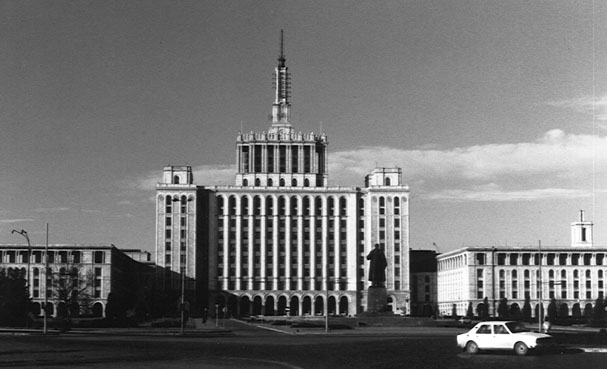
The state printing works in Casa Scânteii, Bucharest, where the Party daily Scânteia was printed.
Engineer Dinu. Comrade Engineer Dinu… A foreman in overalls, with an office of my own, hands stained with printing ink by day and fountain-pen ink by night. Pragmatic about the regime and informed on by many around me, accepted by the authorities because I would not cause much trouble and they needed me to print Scânteia better, which I would probably have helped with out of passion, and perhaps some conviction.
Conviction is not a given. In that other universe it would have depended on what came before: whether my parents had been among the many unjustly destroyed in the Soviet purges, or whether I had a true picture of what was happening at Pitești, Gherla…
Prisons for political detainees. At Pitești, from 1949 to 1952, prisoners were tortured into torturing one another, in what the regime called re-education.
I don’t know what could be found out back then, or, had I found out, what I would have believed. It would have seemed to me that such a thing simply could not happen. Or, knowing and believing, I would have chosen to do nothing, because realistically there was nothing I could do, and a selective blindness, the same one I practise now when I read about what is happening in Gaza and the West Bank, would have let me out of the cognitive dissonance, which in turn would have allowed me, just as now, a more reconciled life.
Ideologically, I probably would not have resisted much. Socialist ideals are very attractive, and the early progress – industrialisation, electrification, literacy, social equity – would have made me want to put my shoulder to it rather than oppose it. Besides, even politically, things would not have been very clear to me. What happened from 1945 into the 1960s was odious, but it did not come to replace a clean political and social order. One personality cult was replaced by another, one dictatorship by another, the exploitation of some social classes by the exploitation of others.
Just as I was wrong about, and blind to, many important things at the start of the twenty-first century, I would have been blind and wrong in the middle of the twentieth.