Apple vs Facebook - The Dawn of a New Privacy Era?
What happened?
Apple, the maker of the iPhone, changed a small setting, and now all the online advertising industry, led by Facebook, is upset, angry and depressed.
The small change is this: After iPhone users install iOS 14.5, when they open any app that wants to access a device ID they will see a pop-up. The pop-up will ask if they want to be tracked and give them an opportunity to opt in.
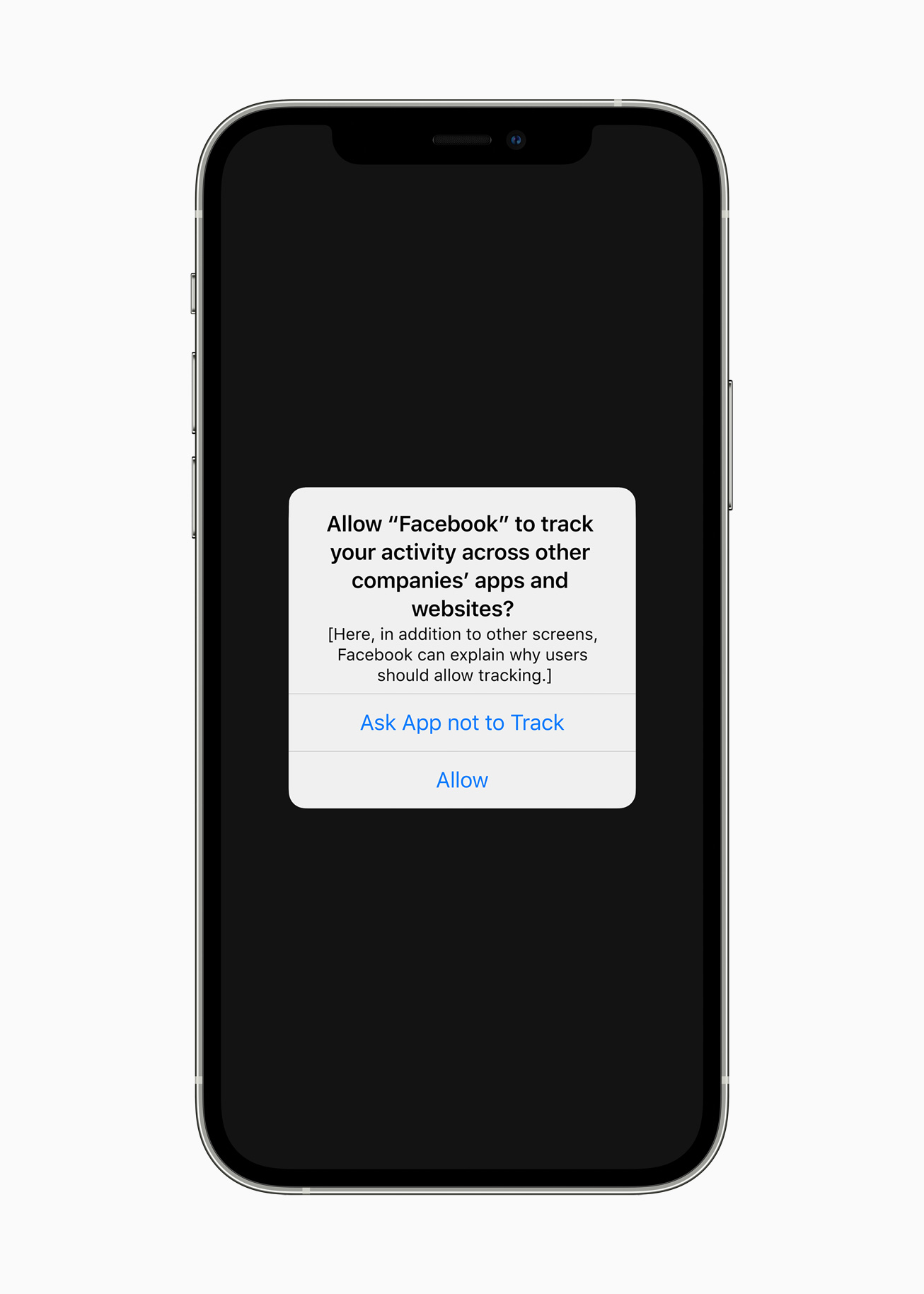
The small pop-up who started the big war. Source: Apple.com
The device ID is a unique number (like a serial number) of the iPhone and it is used by advertisers to find out what apps you installed and how you use them. By looking at the behaviour across multiple applications, these advertisers can create a better image of you so they can target you with more precise ads.
Is this important?
Yes. Targeted advertising is both good and bad, but seriously more bad than good, at least in its current form.
It is good because:
It helps people get ads on topics they are interested in.
It is good for companies paying the ads because they get higher conversion rates (a higher number of people who see the ads buy their products).
Yet, it is also bad and ugly:
It concentrates a lot of power, decision and money to just a handful companies
It forces these companies to use all their talent to keep us scrolling and scrolling. We became hamsters while most brilliant minds of the planet concentrate on making us click on ads instead of ending poverty, hunger or understanding the universe
And the most serious: the profiles are not used only for coffee ads. There is a long series of unethical exploitation of user information so that people are manipulated, for example for political reasons, such as Brexit and U.S. elections. And this can be just the beginning, as if left unregulated, data-driven companies have the potential of ultimately getting to know us better than we do (fears, values, principles).
Apple’s Position
Apple says that transparency is paramount and people need to know what data is collected on them.
Advertisers can still use the device unique identifier, but the user has to consent, by opting-in.
And it is obvious that the large majority of the people, probably all, will just say “No” to being tracked. Because we care about the idea of privacy and saying “No” is easy. Companies are not allowed to trick users into opting in by using incentives or confusing design.
So, goodbye to cross application tracking by default!
Critics’ (aka Facebook’s) Position
Without cross-application tracking by default, the virtual profiles of people will be less complete.
Critics say that if the profile is not good, the advertising is less precise, so the poor corner shop and neighbourhood cafe suffer, as they are not able to segment the public as precisely as before. And thousands of small companies who rely on finding small niches will suffer.
Facebook took the role of defending and representing these small companies. They issued blog posts, paid for advertising in posh newspapers, they created websites, all to try to convince the public how bad this new opt-in is. Facebook even teamed up with some companies to sue Apple, ironically in Germany.
There is no surprise here. Facebook’s core business model is to collect data and keep us stuck to the screens so that they can give our time and attention to advertisers. Anything that attacks this model is potentially an existential threat, so it is absolutely natural for them to freak out.
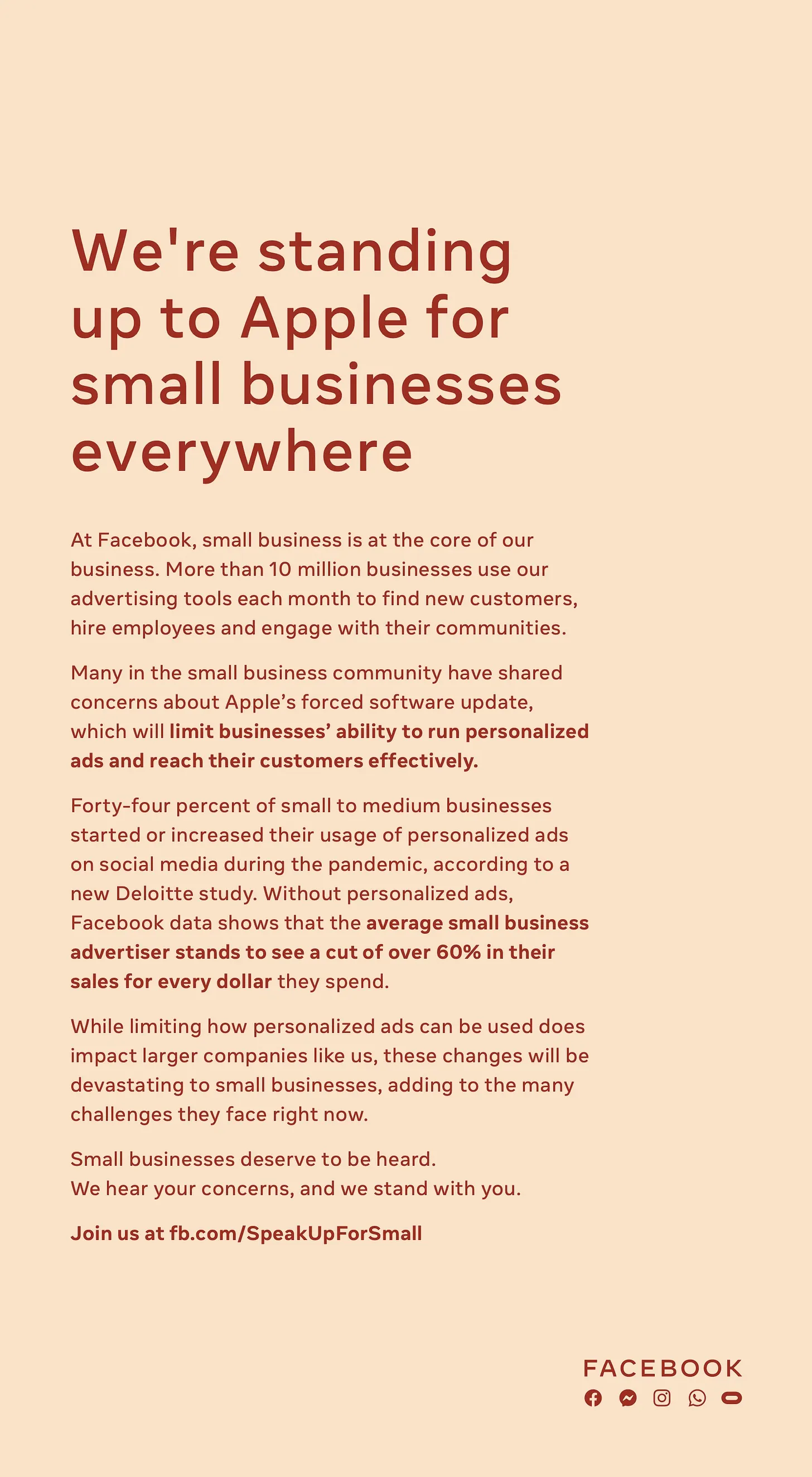
Facebook’s ad in the Financial Times
I read their materials (links at the end) and I was quite amused: There is a FAQ with questions like "Are personalized ads privacy safe?" Answer: "We believe personalized ads and privacy can coexist, so we take a privacy-first approach in all of our work" [SIC]
My Position
I am happy. Because this shows a way to exit the Privacy Paradox: let others do it for you. As said, a small popup window might sound not too important, but is huge.
Is Apple saving the knight in shining armour, here to prevent our privacy and security from the evils of Facebooks and Googles?
No. This move suits them. They sell ads, too and this move will get them some new territory. Therefore is more than PR, their ad sales will increase.
First, Apple is in a good position and can afford to play the good guy’s role in this game. They establish themselves as a leader in privacy, so more sales for their hardware.
Their business, unlike Google and Facebook is not based on processing and exploiting user data for profit. Apple has the privilege of selling iPhones and watches for a huge margin, so they care less about squeezing every bit of data for marketing and resale.
Second, what they did is important, as:
it sends a signal
it sets a new agenda, which others might need to follow
apps that do not respect it or try to find loopholes will be banned from the AppStore
it is changing the role of advertisers in Apple’s ecosystem
Hopefully the new mantra of everybody will be soon “privacy is important, data processing, surveillance and tracking need to be transparent”. And they are big enough to steer the industry in one direction or another.
In practical terms, though, they cannot do much. Facebook can still track the hell out of those people in their ecosystem of apps, so does Google, so does Microsoft, so does any company that makes you log in to use their software. Ever wondered why you have to sign in to play a crappy game? This is one good reason. So the behaviour is still tracked, what is lost is the ability to be tracked across different apps from different developers.
We’re far from a world where data processing is regulated and works for the user. Albeit small, this is a good, essential step, towards a new privacy era.
So what now?
Rejoice. Just a bit, not too much. And consider taking some easy steps to augment Apple’s present, by using some tools and observing some good behaviours:
Tools
Privacy Badger, the mandatory browser extension: https://privacybadger.org/
Find more tools here: PrivacyTools - Encryption Against Global Mass Surveillance https://www.privacytools.io
Behaviours
Before giving your email or phone number to an app ask yourself “why do they need it?”
Use the incognito window whenever you search for delicate issues (any disease symptoms, new job, something you are afraid of, etc.)
Know your rights: particularly if you live in the EU, you can ask for what data any company has on you, you can ask for this data to be sent, or deleted.
Links on the topic
These are the articles I studied while writing this issue. You can also read the issue on the Privacy Paradox.
Facebook’s Website on them standing for the small businesses
Apple iOS 14.5 update includes ‘app tracking transparency’ feature | Apple | The Guardian
Accessing User Data - App Architecture - iOS - Human Interface Guidelines - Apple Developer
To Be Tracked or Not? Apple Is Now Giving Us the Choice. - The New York Times
Apple iOS 14.5 release date with ATT, IDFA restrictions confirmed for next week
Apple’s App Tracking Transparency feature has arrived — here’s what you need to know | TechCrunch
Facebook highlights small businesses as it ramps up Apple criticism | TechCrunch
How To Use App Tracking Transparency Blocker In iOS 14.5 And Later | Redmond Pie
Apple iOS 14.5 release date with ATT, IDFA restrictions confirmed for next week
Apple Is Changing How Digital Ads Work. Are Advertisers Prepared?
Before saying “Until next time!”, I wanted to welcome the two new subscribers who joined since last time! I hope you can enjoy spring wherever you are. And, as the cover of my notebook says:
“Be the reason someone smiles today!”